Underwater positions �� there is no topic that investors would rather avoid talking about.
But as I pointed out in a recent article on diversification, some positions are going to head in the opposite direction of where you want them to.
So the issue is more about when �� or IF �� you should close out any losing positions in your portfolio.
I generally go against the grain when it comes to this type of decision.
See, a lot of experts will say you should just sell a position when it reaches a particular percentage loss… the whole ��cut your losses short and let your winners run�� theory.
For more trading-oriented strategies, I think that can make a lot of sense.
It encourages you to be less emotional about your investments�� and the discipline automatically limits the amount of capital you can lose on any single trade.
But if you have a longer time horizon, or your goal is generating solid investment income, I��d tell you to reconsider creating arbitrary stop loss signals.
In fact, I have no problem sitting on a losing position because I have seen many come roaring back!
Here��s a recent example from one of my own personal portfolios.
On June 28th of last year, I purchase 428 shares of Supervalu, a grocery chain operator and food distribution company.
The stock was already very beaten down and trading at $22.45.
Unfortunately, it continued to head even lower and by October 20th it was at $14.90.
A lot of people would have simply sold by this point.
I actually bought another 500 shares.
I now had $17,058.92 invested in the stock�� no small amount of money.
So you can imagine how gut wrenching it was to see the shares go even a bit LOWER still!
But I was convinced Supervalu was still worth far more than the market price so I held firm.
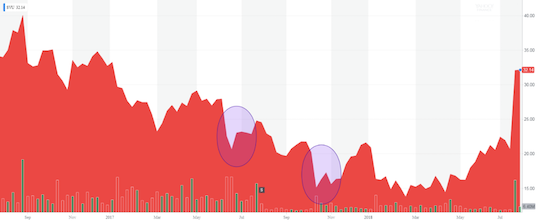
Here��s a chart that shows the action with my buy points circled��
Then, a couple positive developments started happening, including a new activist investor establishing a big stake and pushing for changes…
The stock started rebounding into the $20s��
And then last Thursday, July 26th, United Natural Foods offered to buy the entire company for roughly $32.50 a share �� a 67% premium to the previous day��s closing price.
That��s the big spike you see right at the end of my chart.
End result?
I just booked a $12,740 profit in one year (actually much less on average, since more than half of my position was established when I doubled down in October).
This is hardly a fluke.
It��s actually the SECOND time I��ve seen this happen just with Supervalu.
The first time was back in 2012, when I recommended the stock for my Dad��s real-money $100,000 retirement portfolio�� the one I was sharing with tens of thousands of readers.
Just like this recent time, the grocer��s stock had already been punished pretty severely but that didn��t stop it from going MUCH lower after my Dad (and probably many readers) had bought in.
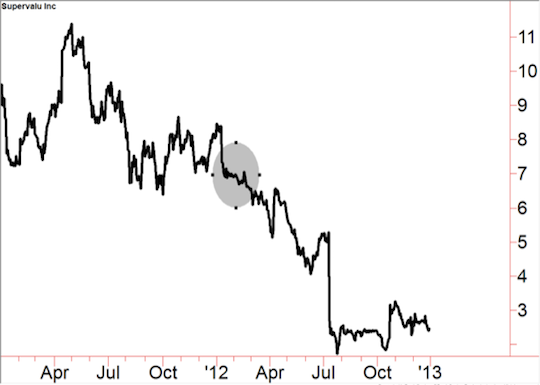
As you can see from this chart below, at one point the shares were actually down more than 60% from Dad��s original entry point in the $7 range.
Wow, talk about a gut-wrenching decline!
Once again, most investors would have certainly dumped at some point, taken a big loss, and moved on.
But nothing about my investment thesis had changed.
And ultimately, I WAS vindicated on Supervalu that time, too, because the company started turning things around like I predicted.
First, it reached an agreement to sell some of its chains �� including Albertsons, Acme, Shaw��s and Star Market �� to a consortium of investors led by Cerberus Capital Management.
Then, its results started improving and the business returned to profitability.
Just take a look at this second chart, which is the same one as above with all the subsequent action added in.
You can see how quickly the stock started bouncing back to �� and ultimately ABOVE �� the original recommendation point.
My Dad ended up booking a solid 30.8% total return on the position once it hit my short-term price target.
And anyone who bought in at lower prices as I continued to pound the table on this stock could have more than TRIPLED their initial investment.
I could keep giving you more examples beyond Supervalu but here��s the bottom line��
If you��re a long-term investor and the fundamental reasons for owning a given position haven��t changed, I believe it makes sense to continue holding … especially if you��re receiving dividends along the way.
Moreover, the better you understand those fundamental reasons for owning a stock, the more confident you��ll be in staying put while the market goes against you.
You may even consider adding more shares on serious weakness.
Because as my latest Supervalu investment just proved, it��s entirely possible to see a 67% jump in one single day �� rewarding anyone with guts, patience and conviction.
To a richer life,

Nilus Mattive
Editor, Rich Life Roadmap


